If you are still checking in here for information about prisoners of war and about my two books, Guests Behind the Barbed Wire and North Across the River, please mark your favorites for my new blog site and come visit.
You will now find us at http://www.genevapow.com/. There are a number of new posts I think you will find interesting. Just click from right here and see the latest posts.
Sunday, October 3, 2010


Friday, July 23, 2010
GENEVA POW IS MOVING TO A NEW SITE.
Beginning this week, the Geneva POW blog site will move to a new location. Please visit us at www.genevapow.com later this week. All of the old posts will be available and can be checked by topic, and new posts will begin shortly.
Thanks to all who have been loyal readers. I hope to continue to provide useful information about his topic beginning in mid-August.
Thanks to all who have been loyal readers. I hope to continue to provide useful information about his topic beginning in mid-August.
Friday, May 28, 2010
Review of Horst Freyhofer Visit to the Aliceville Museum

Horst Freyhofer has been retracing some of his father's footsteps during WWII, and that project led him to the Aliceville Museum on March 11. Christian Freyhofer was a German POW at Camp Aliceville. He had been drafted to fight for Germany in Russia in 1940. Later he was taken prisoner by the British in North Africa. After recovering from serious injuries, he was shipped to the US and spent time in POW camps in Alabama, Mississippi, and Florida.
Freyhofer's children remember him telling stories of how hot is was and how he worked hard "in the swamps." He said he was treated well and even respected by American soldiers and some civilians he encountered, at least until after the German surrender in 1945.
During Christian Freyhofer's time in Camp Aliceville, he was able to pursue his love of acting, and he performed in plays the POWs put on, including Heinrich von Kleist's Der Zerbrochene Krug (shown in photo at upper right). Later, Freyhofer was sent to Camp Gordon Johnston in Lanark, Florida, which was a training camp for American amphibian soldeirs as well as a POW camp location. (NOTE: Hermann Blumhardt also spent time in this camp.)
"It is astounding how much freedom and opportunities POWs had expressing themselves...," said Christian's son Horst in an April 9 thank you letter to the Aliceville Museum. Horst and his brother Udo left Germany for the US to pursue opportunities in "the new world." They were both inspired by their father who told them about the decent treatment and material comfort he experienced at Camp Aliceville. "Descriptions of the food he ate made our mouths water," wrote Horst. "Emaciated kids, that we were, we could only marvel at his descriptions of things we had never heard about, such as pineapples, avocados or shrimp. No wonder we eventually came over here to see for ourselves."
NOTE: The above information is based on an article in the May 2010 issue of Museum News.
The Aliceville Museum, like many other wonderful historical locations, is experiencing difficult times during the current economic challenges. If you are interested in helping preserve WWII history, which the Aliceville Museum is doing so effectively, please consider becoming a museum member. An individual membership is only $25. You can also become a sponsor for a contribution of $100 or more. Contact the museum at museum@nctv.com.
In addition to monetary support, the Aliceville Museum always welcomes donations of artifacts. Here are some of the things currently on their wish list:
PICTURE FRAMES
A LASER PRINTER
KOREAN CONFLICT UNIFORMS AND ARTIFACTS
HISTORIC PHOTOS OF ALICEVILLE
A PHOTO OF 1946 ALICEVILLE COTTOM MILL EMPLOYEES
Saturday, April 24, 2010
The family of Dr./Major Arthur J. Klippen (shown left at Camp Aliceville in 1944) has donated a painting of the Camp Aliceville Station Hospital to the Aliceville Museum in his memory. 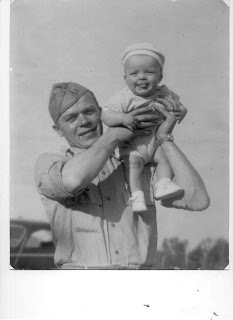 Earline Lewis Jones, a former civilian employee with the camp's Quartermaster's office, has verified that the painting depicts the Station Hospital.
For additional information about Arthur J. Klippen, please see the blog entry for December 15, 2009.
The museum has received another painting recently--a portrait of Elsie Milhelic Ruzic who worked as a civilian employee of the US Corps of Engineers while her husband served in the US Navy in the Pacific. This portrait was donated by the subject's daughter, Susan Ruzic Newshelier.
Both of these paintings were created by German POWs held in Camp Aliceville during WWII. They are on display at the Aliceville Museum in Aliceville, AL http://www.cityofaliceville.com/
 Earline Lewis Jones, a former civilian employee with the camp's Quartermaster's office, has verified that the painting depicts the Station Hospital.
For additional information about Arthur J. Klippen, please see the blog entry for December 15, 2009.
The museum has received another painting recently--a portrait of Elsie Milhelic Ruzic who worked as a civilian employee of the US Corps of Engineers while her husband served in the US Navy in the Pacific. This portrait was donated by the subject's daughter, Susan Ruzic Newshelier.
Both of these paintings were created by German POWs held in Camp Aliceville during WWII. They are on display at the Aliceville Museum in Aliceville, AL http://www.cityofaliceville.com/
Friday, April 23, 2010
Remembering Daisy Earle Day
I had a telephone call a couple weeks ago from a ninety-eight year old woman who lives not far from me. She had read Guests Behind the Barbed Wire and was inquiring about one of the Aliceville residents mentioned in the book--Miss Daisy Earle Day. Miss Day's father owned a grocery store in Aliceville during WWII, and she taught school there at that time.
The name was familiar, but I didn't remember anything else. The woman who called explained that she had gone to Judson College with Miss Day and wondered what had become of her.
When I checked my notes, I knew why I remembered the name. Those of you who have read Guests will remember Mary Lu Keef, the little girl whose father brought the family from New York state when he took a job at Camp Aliceville during the war. Pickens County, Alabama was a strange new world for Mary Lu, who attended Aliceville Elementary School while both of her parents worked at the POW camp. In interviews, she often referred to her third grade teacher as an encouragement and inspiration to her when she came to Aliceville. Turns out that teacher was none other than Miss Day. Mary Lu thought so much of Miss Day that she sought her out for a visit when she returned to Aliceville for one of the POW camp reunions after she grew up.
I sent an e-mail to Mary Bess Paluzzi, director of the Aliceville Museum, to see if she knew the whereabouts of Miss Day, who would also be 98 years old now. Mary Bess remembered her well and noted that she had been the organist for the Aliceville First Baptist Church for fifty years. Her nephew had moved her to a nursing home in Brewton in 2003, and she passed away there in 2008.
I called the woman back and told her what I had been able to find out. Although she was sad to hear that her college friend had passed away, she was pleased to know of the many memories others had of her.
The name was familiar, but I didn't remember anything else. The woman who called explained that she had gone to Judson College with Miss Day and wondered what had become of her.
When I checked my notes, I knew why I remembered the name. Those of you who have read Guests will remember Mary Lu Keef, the little girl whose father brought the family from New York state when he took a job at Camp Aliceville during the war. Pickens County, Alabama was a strange new world for Mary Lu, who attended Aliceville Elementary School while both of her parents worked at the POW camp. In interviews, she often referred to her third grade teacher as an encouragement and inspiration to her when she came to Aliceville. Turns out that teacher was none other than Miss Day. Mary Lu thought so much of Miss Day that she sought her out for a visit when she returned to Aliceville for one of the POW camp reunions after she grew up.
I sent an e-mail to Mary Bess Paluzzi, director of the Aliceville Museum, to see if she knew the whereabouts of Miss Day, who would also be 98 years old now. Mary Bess remembered her well and noted that she had been the organist for the Aliceville First Baptist Church for fifty years. Her nephew had moved her to a nursing home in Brewton in 2003, and she passed away there in 2008.
I called the woman back and told her what I had been able to find out. Although she was sad to hear that her college friend had passed away, she was pleased to know of the many memories others had of her.
Thursday, April 1, 2010
Sylacauga Hosts Second Annual Marble Festival


This post doesn't have much to do with POWs or with my first two books, but I have been working for a year now on a research project that deals with the history of marble quarries in the Sylacauga, Alabama area. I thought my readers might like to see some views of the marble festival that was held there last week.
Sylacauga sits almost on top of a 32 mile long vein of mostly white marble. This sugar-white stone only appears in one other location in the world--Carrera, Italy, which is where Michaelangelo's marble came from.
This was the second annual marble festival in Sylacauga, and sculptors came and worked in the town park where visitors could watch as they coaxed incredibly beautiful images out of the stone. One such piece that my friend Marianne Moates Weber fell in love with and purchased last year shows a highly polished heart emerging from the rough marble.
If you look closely at the piece in the foreground of the lower right photograph above, you will see that it shows the heads of two girls facing in opposite directions. I was told that these are the daughters of the sculptor and that one went to Auburn and one to Alabama, which explains why they face in "opposite" directions.
I am continuing to gather information and interview people who grew up in the marble industry company village of Gantt's Quarry. Anyone who is interested in this story or has information to share is welcome to leave a comment. One thing I am especially looking for at the moment is a photograph of the Gantt's Quarry Methodist Church.
Wednesday, March 3, 2010
Freyhofer Visit Postponed. North Across the River Sold Out.
Yesterday I made the announcement that Horst Freyhofer, the son of a former Camp Aliceville POW, would visit the Aliceville Museum this Thursday, March 4. That visit has been postponed until Thursday, March 11, at 10 a.m.
If you have not yet explored the Aliceville Museum http://cityofaliceville.com/MuseumMain.htm, it is well worth the trip to Pickens County, Alabama. Many artifacts from Camp Aliceville are there, along with correspondence from former POWs and former MPEG guards, and items pertaining to other aspects of World War II.
----------------------------------------------------------------------------------------------
I'd also like to notify my readers today that my first book, North Across the River, is officially sold out. I am extremely grateful to all those who took an interest in this little known tale of the Civil War. This blog will continue to post new information about Roswell and Sweetwater Creek when it becomes available, so please continue to share.
If you have not yet explored the Aliceville Museum http://cityofaliceville.com/MuseumMain.htm, it is well worth the trip to Pickens County, Alabama. Many artifacts from Camp Aliceville are there, along with correspondence from former POWs and former MPEG guards, and items pertaining to other aspects of World War II.
----------------------------------------------------------------------------------------------
I'd also like to notify my readers today that my first book, North Across the River, is officially sold out. I am extremely grateful to all those who took an interest in this little known tale of the Civil War. This blog will continue to post new information about Roswell and Sweetwater Creek when it becomes available, so please continue to share.
Subscribe to:
Posts (Atom)


 Posts
Posts